Thursday, July 28, 2016

IS AMERICA GREAT? DEPENDS ON WHO YOU ASK.

President Obama and his now heir to be Hillary Clinton like to boast about how great America is; the implied unsaid part of the message is, don't complain, it makes us look bad.


Both Obama and Clinton are trying to distract us from what the truth is because neither he or his heir apparent want to admit that the Democratic Establishment has failed miserably in delivering what has been promised over and over again when they ask to be elected and then disappear into the mist of history the day after they take the oath of office.


Rest assured  there is a select group of Americans that Obama and Hillary are speaking to who can declare that America has been great to them. But that's a very small and select group which ironically include the Clinton's who joined the "millionaire club" by pandering to it's members.


So, is America great? Well, it depends on who you ask;


THE DEMOCRATIC PARTY WAS ONCE THE PARTY OF THE NEW DEAL and the ally of organized labor. But by the time of Bill Clinton's presidency, it had become the enemy of New Deal programs like welfare and Social Security and the champion of free trade deals. The end result is that the party which created the New Deal and helped create the middle class has now become “the party of mass inequality.” 


The first piece of evidence is what’s happened since the financial crisis. This is the great story of our time. Inequality has actually gotten worse since then, which is a remarkable thing. This is under a Democratic president who we were assured (or warned) was the most liberal or radical president we would ever see. Yet inequality has gotten worse, and the gains since the financial crisis, since the recovery began, have gone entirely to the top 10 percent of the income distribution.


This is not only because of those evil Republicans, but because Obama played it the way he wanted to. Even when he had a majority in both houses of Congress and could choose whoever he wanted to be in his administration, he consistently made policies that favored the top 10 percent over everybody else. He helped out Wall Street in an enormous way when they were entirely at his mercy.

The elephant in the room that neither Obama or Clinton want Americans to pay attention to is;


Wealth Inequality

Wealth inequality can be described as the unequal distribution of assets within a population. The United States exhibits wider disparities of wealth between rich and poor than any other major developed nation.

Defining Wealth

We equate wealth with “net worth,” the sum total of your assets minus liabilities. Assets can include everything from an owned personal residence and cash in savings accounts to investments in stocks and bonds, real estate, and retirement accounts. Liabilities cover what a household owes: a car loan, credit card balance, student loan, mortgage, or any other bill yet to be paid.

In the United States, wealth inequality runs even more pronounced than income inequality


America is great to the 1%


The share of America’s wealth held by the nation’s wealthiest has changed markedly over the past century. That share peaked in the late 1920s, right before the Great Depression, then fell by more than half over the next three decades. But the equalizing trends of the mid 20th century have now been almost completely undone. At the top of the American economic summit, the richest of the nation’s rich now hold as large a wealth share as they did in the 1920s.


The 21st century has not been kind to average American families. The net worth — assets minus debts — of most U.S. households fell between 2000 and 2011. Only the top two quintiles of the nation’s wealth distribution saw a net increase in median net worth over those years.

The rich don’t just have more wealth than everyone else. The bulk of their wealth comes from different — and more lucrative — asset sources. America’s top 1 percent, for instance, holds nearly half the national wealth invested in stocks and mutual funds. Most of the wealth of Americans in the bottom 90 percent comes from their principal residences, the asset category that took the biggest hit during the Great Recession. These Americans also hold almost three-quarters of America’s debt.

The most visible indicator of wealth inequality in America today may be the Forbes magazine list of the nation’s 400 richest. In 1982, the “poorest” American listed on the first annual Forbes magazine list of America’s richest 400 had a net worth of $80 million. The average member of that first list had a net worth of $230 million. In 2015, rich Americans needed net worth of $1.7 billion to enter the Forbes 400, and the average member held a net $5.8 billion, over 10 times the 1982 average after adjusting for inflation.

Inequality is skyrocketing even within the Forbes 400 list of America’s richest. The net worth of the richest member of the Forbes 400 has soared from $2 billion in 1982 to $76 billion in 2015, far outpacing the gains at either the Forbes 400 entry point or average.


America is not so great to the middle class


The great shrinking of the middle class that has captured the attention of the nation is not only playing out in troubled regions like the Rust Belt, Appalachia and the Deep South, but in just about every metropolitan area in America, according to a major new analysis by the Pew Research Center.

Pew reported in December that a clear majority of American adults no longer live in the middle class, a demographic reality shaped by decades of widening inequality, declining industry and the erosion of financial stability and family-wage jobs. But while much of the attention has focused on communities hardest hit by economic declines, the new Pew data, based on metro-level income data since 2000, show that middle-class stagnation is a far broader phenomenon.

The share of adults living in middle-income households has also dwindled in Washington, New York, San Francisco, Atlanta and Denver. It's fallen in smaller Midwestern metros where the middle class has long made up an overwhelming majority of the population. It's withering in coastal tech hubs, in military towns, in college communities, in Sun Belt cities.

The decline of the American middle class is "a pervasive local phenomenon," according to Pew, which analyzed census and American Community Survey data in 229 metros across the country, encompassing about three-quarters of the U.S. population. In 203 of those metros, the share of adults in middle-income households fell from 2000 to 2014.

Pew defines middle-income households here as those making between two-thirds and twice the national median household income. For a three-person household in 2014, that means an income between about $42,000 and $125,000. The fact that median incomes have declined over this same time frame also means that the bar to get into the middle class is actually lower now than it was in 2000. Pew's metro-level data are also adjusted for household size and local cost of living.

The shrinking middle class is in part a reflection of rising income inequality in America, and of the same underlying and uneven economic forces that have fueled the rise of Donald Trump. And as the middle class has been shrinking, median incomes have fallen, too. In 190 of these 229 metros, the median income dropped over this same time.

As the middle class has shrunk, Pew points out, the lower and upper classes in America have grown in size and significance. In some metros, the middle class is dwindling primarily because families are falling out of it and into the lower class. The share of households in this bottom tier has skyrocketed since 2000, for instance, in Goldbsoro, North Carolina, a railroad junction with an Air Force base.


America is terrible to the working poor; 

(the majority of which are non-white)

The Great Recession deepened the longstanding racial and ethnic wealth divide in the United States. The typical white family held a net worth six times greater than the typical black family at the end of the 20th century. That gap has now doubled. The wealth gap between white and Hispanic households has widened as well.

The billionaires who make up the Forbes 400 list of richest Americans now have as much wealth as all African-American households, plus one-third of America’s Latino population, combined. In other words, just 400 extremely wealthy individuals have as much wealth as 16 million African-American households and 5 million Latino households.

Democrats will say, not all hope is lost. The Working poor just need to be patient. 

In Congress, 53 progressives, including Sens. Bernie Sanders, Elizabeth Warren, Kirsten Gillibrand, Sherrod Brown, Dick Durbin and others, are backing legislation for a $15 federal minimum wage by 2020 and the gradual elimination of the subminimum tipped wage. While action on the minimum wage at any level is unlikely

This flicker of hope might resonate with teens and 20 year olds, but not so much for the 65 and older Americans.

More older Americans – those ages 65 and older – are working than at any time since the turn of the century, and today’s older workers are spending more time on the job than did their peers in previous years, according to a new Pew Research Center analysis of employment data from the federal Bureau of Labor Statistics.

In May, 18.8% of Americans ages 65 and older, or nearly 9 million people, reported being employed full- or part-time, continuing a steady increase that dates to at least 2000 (which is as far back as we took our analysis). In May of that year, just 12.8% of 65-and-older Americans, or about 4 million people, said they were working.


The relatively strong presence of 65-and-older workers is found across age brackets: 65- to 69-year-olds, 70- to 74-year-olds, and those 75 and older. All are working at higher rates than they did in May 2008, the only age groups about which that can be said.

Though we took the current analysis only back to 2000, an earlier Center report noted that the labor force participation rate (that is, workers and those actively seeking employment as a share of a group’s total population) among older adults began rising in the mid-1980s, after declining for more than three decades.

Not only are more older Americans working, more of them are working full-time. In May 2000, 46.1% of workers ages 65 and older were working fewer than 35 hours a week (the BLS’ cutoff for full-time status). The part-time share has fallen steadily, so that by last month only 36.1% of 65-and-older workers were part-time.


America is a disaster zone to the poverty striken


In 2010, the poverty threshold was $22,314 for a family of four.

15.1%15.1 percent— just over 46 million Americans— were officially in poverty in 2010. This is an increase from 12.5 percent in 2007.

27.4%Among racial and ethnic groups, African Americans had the highest poverty rate, 27.4 percent, followed by Hispanics at 26.6 percent and whites at 9.9 percent.

45.8%45.8 percent of young black children (under age 6) live in poverty, compared to 14.5 percent of white children.

28.0%In 2011, 28.0 percent of workers earned poverty-level wages ($11.06 or less an hour).

18-25 Workers earning poverty-level wages are disproportionately female, black, Hispanic, or between the ages of 18 and 25.

1.8x The United States spends less on social programs (16.2 percent of GDP) than similarly developed countries (21.3 percent of GDP), has a relative poverty rate (the share of the population living on less than half of median household income) 1.8 times higher than those peer nations, and has a child poverty rate more than twice as high.

Almost 50 million people in the U.S. are poor using the supplemental measure, compared to the 47 million using the official measure.

Food stamps (formally known as SNAP) keep about five million people out of poverty, according to the supplemental measure.

Without Social Security more than half of all Americans 65 and over would be in poverty. (Both supplemental and traditional poverty measures include Social Security benefits.)

Under the supplemental measure, which includes cost-of-living differences, poverty is much higher in expensive states like California and New York, and lower in places like Alabama and Kentucky.

The poverty rate for children goes down under the supplemental measure and it goes up for those 65 and older. That's because the supplemental measure includes the impact of out-of-pocket medical expenses (which are high for senior citizens) and of certain government benefits that go disproportionately to children.

In other supplemental-poverty-related news, a study out of UC Berkeley finds that using the supplemental measure is especially useful in identifying the most serious cases: families that are chronically poor.

Monday, June 13, 2016

DEAR HILLARY; WHO IS RAJIV K. FERNANDO?

That was the question a lot of concerned government officials had when Rajiv was given a seat on the International Security Advisory Board (ISAB) by Hillary Clinton.


“We had no idea who he was,” one board member told ABC News.

Fernando’s lack of any known background in nuclear security caught the attention of several board members, and when ABC News first contacted the State Department in August 2011 seeking a copy of his resume, the emails show that confusion ensued among the career government officials who work with the advisory panel.


Fernando himself would not answer questions from ABC News in 2011 about what qualified him for a seat on the board or led to his appointment. When ABC News finally caught up with Fernando at the 2012 Democratic convention, he became upset and said he was "not at liberty" to speak about it. Security threatened to have the ABC News reporter arrested.

It was soon revealed that even though Rajiv was not qualified for a seat on the ISAB he was definately qualified to be labeled a crony of Hillary's as demonstrated by the hundreds of thousands of dollars he pumped into Hillary's campaigns and, more importantly hundreds of thousands of dollars he "donated" to the Clinton Foundation which is more and more begining to look like nothing more than a money laundering machine for "bribes for favors" which Hillary and Bill are notorious for.


Fernando's history of campaign giving dated back at least to 2003 and was prolific -- and almost exclusively to Democrats. He was an early supporter of Hillary Clinton's 2008 bid for president, giving maximum contributions to her campaign, and to HillPAC, in 2007 and 2008. He also served as a fundraising bundler for Clinton, gathering more than $100,000 from others for her White House bid. After Barack Obama bested Clinton for the 2008 nomination, Fernando became a major fundraiser for the Obama campaign. Prior to his State Department appointment, Fernando had given between $100,000 and $250,000 to the William J. Clinton Foundation, and another $30,000 to a political advocacy group, WomenCount, that indirectly helped Hillary Clinton retire her lingering 2008 campaign debts by renting her campaign email list.


It also goes a long way to explain why Hillary would need a private email server in order to conduct these seedy deals outside government oversight.


Newly released State Department emails help reveal how a major Clinton Foundation donor was placed on a sensitive government intelligence advisory board even though he had no obvious experience in the field, a decision that appeared to baffle the department’s professional staff.

The emails further reveal how, after inquiries from ABC News, the Clinton staff sought to “protect the name” of the Secretary, “stall” the ABC News reporter and ultimately accept the resignation of the donor just two days later.

Copies of dozens of internal emails were provided to ABC News by the conservative political group Citizens United, which obtained them under the Freedom of Information Act after more the two years of litigation with the government.

The appointment qualified Fernando for one of the highest levels of top secret access, the emails show. Among those with whom Fernando served on the International Security Advisory Board was David A. Kay, the former head of the Iraq Survey Group and United Nations Chief Weapons Inspector; Lt. Gen. Brent Scowcroft, a former National Security Advisor to two presidents; two former congressmen; and former Sen. Chuck Robb. William Perry, the former Secretary of Defense, chaired the panel.

“It is certainly a serious, knowledgeable and experienced group of experts,” said Bruce Blair, a Princeton professor whose principal research covers the technical and policy steps on the path toward the verifiable elimination of nuclear weapons. “Much of the focus has been on questions of nuclear stability and the risks of nuclear weapons use by Russia and Pakistan.”

The newly released emails reveal that after ABC News started asking questions in August 2011, a State Department official who worked with the advisory board couldn’t immediately come up with a justification for Fernando serving on the panel. His and other emails make repeated references to “S”; ABC News has been told this is a common way to refer to the Secretary of State.


Investigation: How Did Clinton Donor Get on National Security Board? Video - ABC News


Newly released State Department emails help reveal how a major Clinton Foundation donor was placed on a sensitive government intelligence advisory board even though he had no obvious experience in the field, a decision that appeared to baffle the department’s professional staff.


The emails further reveal how, after inquiries from ABC News, the Clinton staff sought to “protect the name” of the Secretary, “stall” the ABC News reporter and ultimately accept the resignation of the donor just two days later.


Copies of dozens of internal emails were provided to ABC News by the conservative political group Citizens United, which obtained them under the Freedom of Information Act after more the two years of litigation with the government.


A prolific fundraiser for Democratic candidates and contributor to the Clinton Foundation, who later traveled with Bill Clinton on a trip to Africa, Rajiv K. Fernando’s only known qualification for a seat on the International Security Advisory Board (ISAB) was his technological know-how. The Chicago securities trader, who specialized in electronic investing, sat alongside an august collection of nuclear scientists, former cabinet secretaries and members of Congress to advise Hillary Clinton on the use of tactical nuclear weapons and on other crucial arms control issues.


Do you have information about this or another story? CLICK HERE to send your confidential tip in to Brian Ross and the ABC News Investigative Unit.


“We had no idea who he was,” one board member told ABC News.


A State Department photograph shows the 2011 International Security Advisory Board. Rajiv Fernando is seated on the far left of the image.more +


Fernando’s lack of any known background in nuclear security caught the attention of several board members, and when ABC News first contacted the State Department in August 2011 seeking a copy of his resume, the emails show that confusion ensued among the career government officials who work with the advisory panel.


“I have spoken to [State Department official and ISAB Executive Director Richard Hartman] privately, and it appears there is much more to this story that we’re unaware of,” wrote Jamie Mannina, the press aide who fielded the ABC News request. “We must protect the Secretary’s and Under Secretary’s name, as well as the integrity of the Board. I think it’s important to get down to the bottom of this before there’s any response.


“As you can see from the attached, it’s natural to ask how he got onto the board when compared to the rest of the esteemed list of members,” Mannina wrote, referring to an attachment that was not included in the recent document release.


Fernando himself would not answer questions from ABC News in 2011 about what qualified him for a seat on the board or led to his appointment. When ABC News finally caught up with Fernando at the 2012 Democratic convention, he became upset and said he was "not at liberty" to speak about it. Security threatened to have the ABC News reporter arrested.
more +


Fernando's expertise appeared to be in the arena of high-frequency trading -- a form of computer-generated stock trading. At the time of his appointment, he headed a firm, Chopper Trading, that was a leader in that field.


Fernando's history of campaign giving dated back at least to 2003 and was prolific -- and almost exclusively to Democrats. He was an early supporter of Hillary Clinton's 2008 bid for president, giving maximum contributions to her campaign, and to HillPAC, in 2007 and 2008. He also served as a fundraising bundler for Clinton, gathering more than $100,000 from others for her White House bid. After Barack Obama bested Clinton for the 2008 nomination, Fernando became a major fundraiser for the Obama campaign. Prior to his State Department appointment, Fernando had given between $100,000 and $250,000 to the William J. Clinton Foundation, and another $30,000 to a political advocacy group, WomenCount, that indirectly helped Hillary Clinton retire her lingering 2008 campaign debts by renting her campaign email list.


The appointment qualified Fernando for one of the highest levels of top secret access, the emails show. Among those with whom Fernando served on the International Security Advisory Board was David A. Kay, the former head of the Iraq Survey Group and United Nations Chief Weapons Inspector; Lt. Gen. Brent Scowcroft, a former National Security Advisor to two presidents; two former congressmen; and former Sen. Chuck Robb. William Perry, the former Secretary of Defense, chaired the panel.


“It is certainly a serious, knowledgeable and experienced group of experts,” said Bruce Blair, a Princeton professor whose principal research covers the technical and policy steps on the path toward the verifiable elimination of nuclear weapons. “Much of the focus has been on questions of nuclear stability and the risks of nuclear weapons use by Russia and Pakistan.”


The newly released emails reveal that after ABC News started asking questions in August 2011, a State Department official who worked with the advisory board couldn’t immediately come up with a justification for Fernando serving on the panel. His and other emails make repeated references to “S”; ABC News has been told this is a common way to refer to the Secretary of State.


“The true answer is simply that S staff (Cheryl Mills) added him,” wrote Wade Boese, who was Chief of Staff for the Office of the Under Secretary of State for Arms Control and International Security, in an email to Mannina, the press aide. “Raj was not on the list sent to S; he was added at their insistence.”


Mills, a former deputy White House counsel, was serving as Clinton’s chief of staff at the time, and has been a longtime legal and political advisor.


Four minutes later, Boese wrote to his boss, Richard Hartman, to alert him that Ellen Tauscher, who was then the Undersecretary for State for Arms Control and International Security Affairs, would be meeting with Mills to devise a response to the ABC News request.


“Sorry this has become a headache,” he wrote.


Hartman wrote the next morning to say he would “come up and brief you... about where Raj Fernando stands and the ABC News investigative journalist inquiries. You do need to hear about it.” Separately, in an email to another official, Hartman noted that it was "Cheryl Mills, who added Mr. Fernando’s name to the list of ISAB nominees."


When ABC News sent a follow-up inquiry about the qualifications of another board appointee, Massachusetts state Rep. Harold P. Naughton, Jr., Boese wrote to Hartman to say the department would have a far easier time explaining Naughton’s credentials. “The case for Rep. Naughton is an easy one. We are on solid ground,” he said.


By this point, Fernando himself had been looped into the discussion. He and Hartman exchanged emails, but the entire text of Fernando’s letter was redacted by the State Department prior to its release.


Twice, Mannina was instructed to stall with ABC News, before Mills sent a public statement. It announced Fernando’s abrupt decision to step down.


“Mr. Fernando chose to resign from the Board earlier this month citing additional time needed to devote to his business,” it reads, noting that membership on the board was required to be “fairly balanced in terms of the points of view represented and the functions to be performed by the advisory committee.”


“As President and CEO of Chopper Trading, Mr. Fernando brought a unique perspective to ISAB. He has years of experience in the private sector in implementing sophisticated risk management tools, information technology and international finance,” the statement says.


The statement was emailed to ABC News two days after Fernando’s resignation and four days after the initial ABC News inquiry.


Fernando’s letter of resignation to Clinton says he “intended to devote a substantial amount of time to the work of ISAB in furtherance of its objectives. However, the unique, unexpected, and excessive volatility in the international markets these last few weeks and months require[d him] to focus [his] energy on the operations of [his] company.”


Additional emails collected from Hillary Clinton’s personal server only hint at her possible involvement in Fernando’s selection to the board. The records request for documents about Fernando’s appointment produced a chain of correspondence from 2010 with the subject line “ISAB” -- or International Security Advisory Board. In those, Mills writes, “The secretary had two other names she wanted looked at.” The names are redacted. Mills then forwarded the response to “H,” which is the designation for Clinton’s personal account. Three minutes later Clinton forwards the email chain to another State official and says simply, “Pls print.”


The Clinton campaign declined requests from ABC News to make Mills available for an interview. Campaign spokesman Nick Merrill deferred to the U.S. State Department, which issued a statement saying the board’s charter specifically calls for a membership that reflects “a balance of backgrounds and points of view. Furthermore, it is not unusual for the State Department Chief of Staff to be involved in personnel matters.”


Andrew Harrer/Bloomberg/Getty ImagesCheryl Mills, former State Department chief of staff under former Secretary of State Hillary Clinton, attends a House Select Committee on Benghazi hearing in Washington, Oct. 22, 2015.more +


Fernando did not respond to messages left by ABC News at home and mobile numbers listed for Fernando, nor to a letter left at the office of his current business.


Today State Department spokesperson Mark Toner told reporters that Fernando had been fully vetted, but Toner said he could not speak to his specific qualifications. When asked if he came from a security background, Toner said, “I don’t believe so.”


“I apologize, I don’t have his [resume] in front of me,” Toner said. “All I know is that the charter does lay out or stipulate that [they're] looking for a broad range of experiences. It’s not unimaginable that a businessman, an international businessman, might bring a certain level of expertise or knowledge or experience to such a job.”


The State Department’s website lists former members of the ISAB, but Fernando’s name is not among them. Toner was unable to explain why the name was missing and when asked if the list was comprehensive, said, “Apparently not.”


As is customary with a new administration, the make-up of the board changed substantially when Clinton took over the State Department, according to Amb. James Woolsey, who served on the panel from 2006 to 2009. But the seriousness of its mission remained the same.


He said the board’s primary purpose was to gather an array of experts on nuclear weapons and arms control to constantly assess and update the nation’s nuclear strategy.


“Most things that involve nuclear weapons and nuclear strategy are dealt with at a pretty sensitive basis -- top secret,” he said, noting that participants meet in a secure facility and are restricted in what materials they can discuss.


That is not typically the realm of political donors, Woolsey said. Though, he added, it would not be impossible for someone lacking a security background to make a contribution to the panel. “It would depend on how smart and dedicated this person was... I would think you would have to devote some real time to getting up to speed,” he said.


Fernando is now a board member of a private group called the American Security Project, which describes itself as “a nonpartisan organization created to educate the American public and the world about the changing nature of national security in the 21st Century.” He also identifies himself online as a member of the Chicago Council on Global Affairs and says he's involved with a Washington think tank.


And he continued to donate to Democrats, and to Clinton. He emerged as one of the first “bundlers” to raise money for Clinton’s 2016 bid. And in July 2015, he hosted a fundraiser for Clinton at his Chicago home. Fernando has also continued to donate to the Clinton Foundation. He now is listed on the charity’s website as having given between $1 million and $5 million.


About six months after Fernando resigned from the State Department advisory board, he was invited to attend a White House State Dinner, honoring the British Prime Minister. And this summer Fernando will serve as a super delegate at the Democratic National Convention. According to Chicago media reports, he has committed to supporting Clinton.


ABC News' Andrea GonzalesPaul contributed to this report.


The following emails were obtained by the conservative political group Citizens United, which obtained them under the Freedom of Information Act, and were provided to ABC News. ABC News has arranged the emails in chronological order. Scroll through the emails below or CLICK HERE to open them in a new window.

Sunday, June 12, 2016

TROLLING HILLARY: THE STRUGGLE CONTINUES

If there's anyone that deserves to be trolled it's Hillary.  Given her uncanny ability to dodge the facts and obsessively lie about everything and anything she is accused of being guilty of there's no way to take her on but to drop down to a level that she operates on.


An example of how nasty Hillary and the Establishment that supports is, is how Bernie has been treated; going as far as even using Obama and Warren to try and crush the movement he represents.


A recent photo on the front page of the LA Times (owned and operated by corporate goons) says it all. You know what they say about a picture being worth a 1,000 words.


A tired - beaten old man being escorted out the door by a tired and badly bruised black man who is desperate to save what little there is of a legacy battered by the Establishment; both right and left. 

The media; bought and operated by the Billionaires and Millionaires Bernie scoffs at are consistently hard at work creating images that depict Sanders as a lost cause; and they are very good at it. 

These insidious forces are frightened of the Bernie supporters because they are made up of the youngest and the brightest America has to offer and are way too informed and tech-savvy to be easily swayed.  These pumped up Millennials want a future they can believe in an it's certainly not what Hillary and the Establishment are dishing up. 


The Democratic Party derailed Bernie: How the establishment has worked to discredit Sanders’ movement - Salon.com


The powerful and far-reaching presence the Bernie Sanders campaign has on social media, and the enthusiasm of young Sanders supporters online, many of whom have been labeled trolls, “Bernie Bros,” “BernieBots,” and — more egregiously — sexists and racists by Democratic partisans and the corporate media over the past year. Sanders has such a passionate online base that David Brock and the Clinton campaign felt it necessary not only to pay legitimate trolls to attack them, but to make bogus generalizations intended to discredit the entire movement.

Throughout the primary season, a narrative has formed — thanks in large part to an uncritical media’s willingness to accept unsubstantiated reports (like chair-throwing and other violence in Nevada) — that Sanders supporters are a bunch of sexist, brutish, violent, and even racist white male trolls and serial harassers (the last charge, which has been exploited by influential journalists and establishment figures to evade any substantive criticisms, is perhaps the most troubling, for the very reason that it undermines people who are genuinely harassed online — which is a very real problem, especially for women and people of color).

Of course, there are indeed anti-Clinton/pro-Bernie trolls on social media — you’d be hard pressed to find any political movement that doesn’t have its share of trolls and assholes, and anyone who thinks their side is troll-free is either naive or self-absorbed. As The Intercept’s Glenn Greenwald recently put it on Twitter: “Self-centered people always think their own group is free of trolls because they’re never targeted by them.”

Interestingly enough, polling data indicates that Clinton supporters have been more aggressive than Sanders supporters on social media and the internet, while — not surprisingly — Trump supporters have been the most aggressive by a long shot. A poll supported by Craigslist.com founder Craig Newmark found that 57 percent of Americans say Trump supporters are very aggressive and/or threatening online, 30 percent say the same for Clinton supporters, and 16 percent for Sanders supporters (while 68 percent say Sanders supporters are not that aggressive, 52 percent for Clinton supporters, and 30 percent for Trump supporters).

Unfortunately, “troll” and “harassment” have become terms that are now impulsively hurled by Democratic partisans at anyone who criticizes or disputes their opinion or a claim they’ve made, whether on social media or in a publication. Accusing someone of harassment — even when the person is making a valid argument (admittedly, sometimes substantive arguments can be made in a rude or condescending manner, but is being rude or impolite harassment?) — is an easy way to avoid their argument and discredit them in the future.

Friday, June 3, 2016

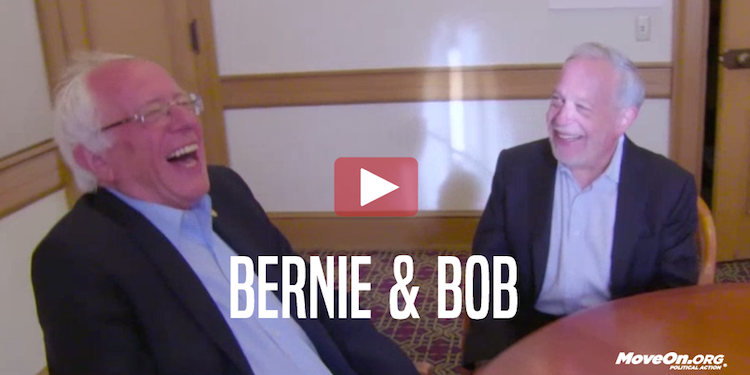
WHEN BERNIE WINS WE ALL WIN

BernieandBob
Bernie's campaign has given voice to countless Americans who are hell-bent to take back our country. 
It has changed our nation and our politics—hopefully forever. Now it's up to all of us. To you and me and the courage and grit it's going to take to fulfill the promise of this historic moment.


Wednesday, March 23, 2016

WHY REPUBLICANS WANT TO RUN AGAINST HILLARY

Why do Republicans (and the media)  frequently mention Hillary and say little or nothing about Bernie when reporting on General Election match-ups?


Republicans believe that Hillary will lose the election regardless who she runs against in November. Her loss is almost guaranteed because she will lose the Independents and Crossovers who will cast their votes for "anyone but Hillary."


They see Hillary as the gift that keeps on giving when the GOP attack dogs begin to feast on her. The baggage she carries is "huuuge" (as Bernie would say) and her opponents will have a field day tearing down her (and her husbands) reputation(s). The theme is obvious; can she be trusted? Is she honest? And, there's plenty of evidence to support that she loses on both counts.


There's her secret email accounts that she shared classified information. There's the secret speeches she made to Wall Street bankers who make up the bulk of her donor base. There's the hundred of millions of dollars her and Bill have pulled in for doing nothing more than peddling their influence and connecting power brokers.


Bernie Sanders, on the other hand, scares Republicans because he comes to the race with almost no baggage and is unshakable when it comes to his position on the issues Americans care about; the economy, healthcare, education, the infrastructure, income inequality, immigration, and political corruption.  These are issues Republicans would rather not talk about because they; as well as Establishment Democrats, are a part of the problem and have no solutions.


In a General Election Bernie not only wins the votes of the majority of Millennials who are coming out in droves to vote for him, but also Independents and Crossovers that his message rings true with.


High turnout was reported among Democrats in all three states, with voters waiting hours in line in a few locations and some complaining that officials had not opened enough caucus sites or polling places.

Even after Arizona was called for Clinton, Sanders urged voters to stay in line, hoping to narrow the delegate gap in a state in which Democrats award them proportionally. In fact, Clinton’s Arizona margin narrowed as the night wore on—and Sanders’s dominating performances in Utah and Idaho allowed him to claim the majority of delegates who were up for grabs on Tuesday.


With Donald Trump on track to become the Republican nominee, Sanders has highlighted polls that show him beating the New York businessman in a general election by a wider margin than Clinton.


“There is no question that you are looking at the strongest Democratic candidate,” he said Monday.


His campaign team has repeatedly described the primary calendar as skewed in Clinton’s favor for the first half of the nominating contests and expect Sanders to pick up steam in western states, such as Washington, which holds its Democratic caucuses Saturday.


“We’re at halftime here, and we agree we’re behind, but we think we’re going to win this game,” said Sanders strategist Tad Devine last week.


Jeff Weaver, Sanders’ campaign manager, expressed frustration with the sentiment that Clinton was already locking down the nomination, calling it a “media drumbeat to essentially disenfranchise half of the Democratic voters.”

Wednesday, March 16, 2016

AMERICA'S "DOCTOR DRIVEN" DRUG CARTEL; BIG PHARMA

The media makes banner headlines about notorious Mexican Drug lords who invade the US peddling their nasty drugs with little or no mention that there is an enormous "demand" from Americans for these drugs. Why such a big demand you might ask?


It turns out that the  reason(s) for the drug epidemic can be laid at the door of  our  very own "home grown" medical doctors who, are defacto drug dealers for  none other than Big Pharma.

How did doctors, who pledge to do no harm, let the use of prescription narcotics get so out of hand?

As it turns out this cozy relationship between doctor(s) and drug manufacturers has existed for decades but the boom came  in the prescribing of narcotics by outpatient doctors, driven partly by the pharmaceutical companies that sold those drugs. Between 1999 and 2010, sales of these “opioid analgesics”—medications like Vicodin, Percocet, and OxyContin—quadrupled.


By 2010, the United States, with about five per cent of the world’s population, was consuming ninety-nine per cent of the world’s hydrocodone (the narcotic in Vicodin), along with eighty per cent of the oxycodone (in Percocet and OxyContin), and sixty-five per cent of the hydromorphone (in Dilaudid).


As narcotics prescriptions surged, so did deaths from opioid-analgesic overdoses—from about four thousand to almost seventeen thousand. 

Studies have shown that patients who receive narcotics for chronic pain are less likely to recover function, and are less likely to go back to work. The potential side effects of prescription narcotics include constipation, sexual dysfunction, cognitive impairment, addiction, and overdosing. 

When patients receive narcotics for long periods, they can even become more sensitive to pain, a condition called hyperalgesia. (J. David Haddox, the vice-president of health policy at Purdue Pharma—the manufacturer of OxyContin—acknowledged “opioid analgesics have sometimes been associated with diminished pain relief in the face of increasing doses.”)


What’s more, no medication reliably eliminates pain in all patients, and narcotics are no exception. And there isn’t good evidence that the prescription of narcotics to treat chronic, non-cancer pain is effective over long periods: most studies of prescription narcotics last only twelve to sixteen weeks.

Sunday, March 13, 2016

HILLARY; A "NATURAL" BS ARTIST!

Will the real Hillary please stand up.


One Hillary wants us to believe that she is just an average American struggling to the top with the best of intentions; helping fellow Americans with their struggles.


The image she conveys is a warm fuzzy.


Clinton acknowledged during Wednesday’s Democratic debate that she was “not a natural politician” and expanded on the theme in an interview with the SiriusXM radio show “The Mayor” the following day.

“This is harder for me,” she said. “I admire the skills my husband and President Obama have. They’re charismatic and they’re compelling and they’re great orators. I do get up every day and say, ‘What can I do to try make someone’s life better?’”


Now, let's compare that with the other Hillary. The one who when asked about the millions of dollars she is pulling in for making speeches to the rich and powerful;


Anderson Cooper: "But did you have to be paid $675,000 [for three speeches to Goldman Sachs]?"

Hillary Clinton: "Well, I don't know. That's what they offered."


Even the most ardent Clinton supporter should be asking; Is Hillary being "truthful" with us?

Hillary Clinton is taking a new tack to boost her image in the Democratic presidential campaign.

Clinton acknowledged during Wednesday’s Democratic debate that she was “not a natural politician” and expanded on the theme in an interview with the SiriusXM radio show “The Mayor” the following day.

“This is harder for me,” she said. “I admire the skills my husband and President Obama have. They’re charismatic and they’re compelling and they’re great orators. I do get up every day and say, ‘What can I do to try make someone’s life better?’”

Few objective observers view such comments as spontaneous moments of candor. Rather, they see them as part of a strategy to warm up perceptions of the Democratic front-runner, who is seen suffering an enthusiasm deficit by comparison with her rival Bernie Sanders.

“It’s an attempt — maybe successful — to get people to see her less as a politician and as more of a personality,” said Hank Sheinkopf, a New York-based Democratic strategist who has worked for Clinton in the past but has no involvement in the current campaign. “She is attempting to remove herself from an elite class of people who tend to be disliked right now — professional politicians.”

Clinton has an uphill climb ahead if she is to freshen up her public image, however.

Polling shows that while voters respect her experience and toughness, many find her untrustworthy.

Given Hillary's track record it's understandable why voters are suspicious;


Hillary is veering from the truth when she suggests her $225,000 per speech fee, paid three times by Goldman Sachs, was "what they offered."

It was not what they offered -- it was what Team Hillary demanded.

A review of her 2014 tax return posted on her website shows that $225,000 was her minimum fee.

She received $225,000 for 34 of the 41 speeches listed on her tax return. Of the remaining 7 speeches, two were for 250,000 and the others for $265,000, $275,000, $285,000, $305,000 and $400,000. In total she received $9,680,000 for these speaking engagements in 2013.

Wall Street firms funded 14 of her 41 talks. In addition to Goldman Sachs, the list includes Morgan Stanley, Deutsche Bank, Fidelity Investments UBS and Bank of America. Her benefactors also include hedge funds and private equity firms like Apollo Management and Kohlberg, Kravis, Roberts.

Why did Hillary Take the Money?

Carl Bernstein, of Watergate fame and Hillary biographer, commented on CNN that the White House is "horrified that Clinton is blowing up her own campaign." He said they can't believe she took the money and didn't see the ethical problems that would dog her.

It is not credible for her to argue that she took the money because she wasn't sure she was going to run for president or that she was "dead broke." She and Bill hauled in $139 million from 2007 to 2014.

It seems enormously difficult for Hillary to explain, even to herself, why she took the money. One possibility is that she wanted to send a message that she would not use populist rage against Wall Street during her campaign. That instead she would work with Wall Street to solve financial problems for the good of the country. We will find out more when (if) her transcripts are ever found and released.

But the boarder reason may lie in the fundamental relationship between the Clintons and their wealthy friends and benefactors. Hillary, Bill and Chelsea (whose husband is a hedge fund partner) believe that Wall Street is a vital part of economy, composed mostly of very bright, honorable and talented people, like their classmates at Yale and Stanford. Sure, every now and again there are a few bad apples, but the barrel is fundamentally sound.

How could she be so politically tone deaf on this issue?

It's because she still lives in world surrounded by so many of the best and brightest in and around Wall Street. Attacking them would be like attacking her community of friends and financial supporters. How could taking money from such decent, talented and productive people be wrong? Isn't it fair to earn a $225,000 speaking fee, given that's what Wall Street elites earn per hour?

So What's Wrong with Taking Money from Wall Street?

The pundits point out that she has created a "perceived" conflict of interest, whether real or imagined. In essence they are saying that there's nothing inherently wrong with taking the money. It's not really tainted.

Hillary states that she never changed her vote due to campaign contributions. But evidence is mounting via previous accounts by Elizabeth Warren, that Hillary may have switched her position on bankruptcy laws to please her Wall Street contributors after becoming the Senator New York.

But these attacks miss the most basic question: Is money tainted? Is it blood-money?

Sanders believes it is by arguing that "the business model of Wall Street is fraud."

There is considerable data to support him.